
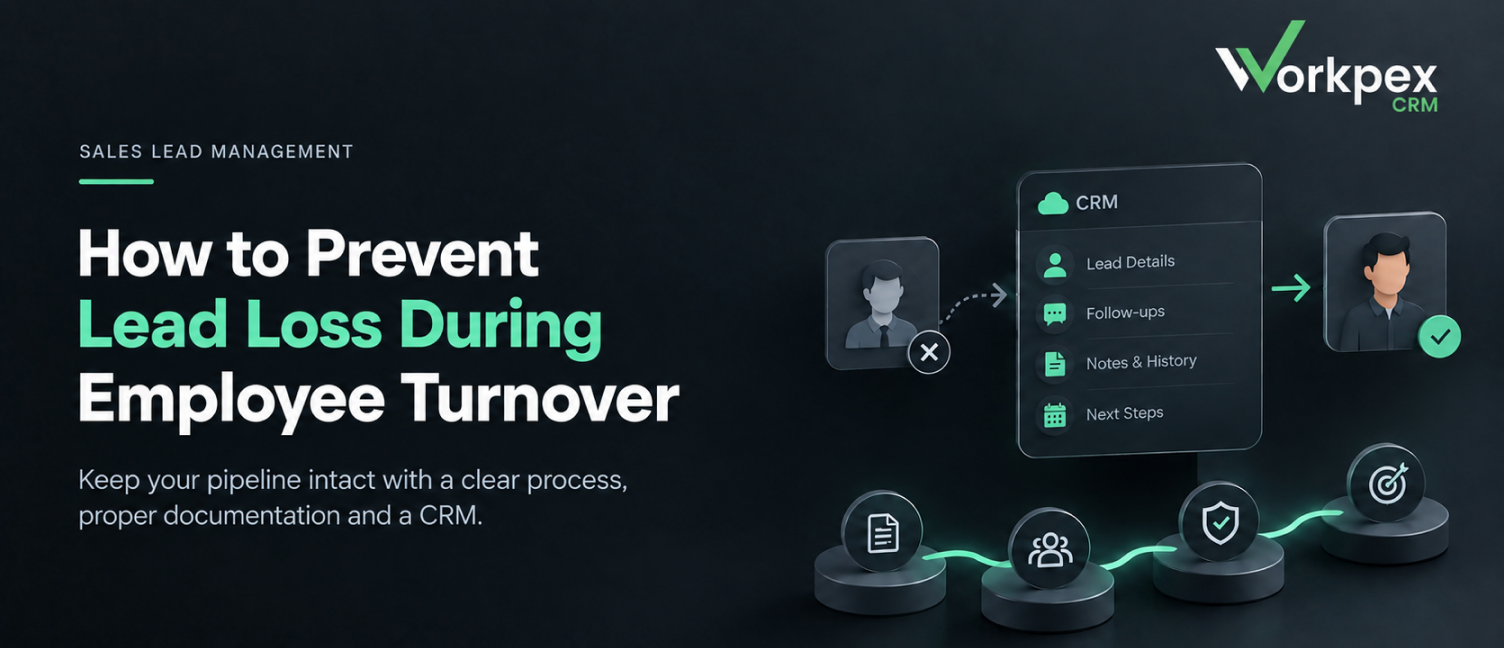
Sales teams change constantly. People get promoted, switch companies, or move into new roles. That kind of turnover is normal. Losing active leads every time it happens is not.
Knowing how to prevent lead loss during employee turnover comes down to three habits. Documenting conversations as they happen. Running a defined handoff before a rep exits. Moving ownership fast enough that a prospect never feels the gap. None of this needs complex technology. It just needs a process the whole team follows, regardless of who is coming or going.
What Happens to Leads When a Sales Rep Leaves
It helps to be specific about what happens to leads when a sales rep leaves. Without a structured offboarding process, the damage rarely shows up all at once. It builds slowly.
A scheduled call goes unmade. A follow-up email never gets sent. A lead sits in the CRM, technically still active, but nobody is checking in on it because nobody has taken it over.
A few patterns repeat in businesses that do not plan for this:
Conversations stall because no one else knows what was last discussed
Dates that only lived in the departing rep's personal calendar get missed entirely
Leads sit unowned for days or weeks while managers work out who should take over
Institutional knowledge about a prospect's needs and objections is left with the employee
Stalled opportunities only surface during a routine pipeline review, often after the damage is done
The root problem is not the departure itself. It is that information about each lead lived in one person's head, inbox, or notebook, instead of a shared system the whole team could access.
Why This Risk Is Bigger Than It Looks
It is tempting to treat this as a minor administrative gap, something to tidy up once a replacement is hired. In practice, leads that go cold during a transition rarely come back on their own.
A prospect who hears nothing for two or three weeks will not wait around wondering what happened. They will assume the business has lost interest and start looking at whichever vendor is still responsive.
The impact also depends on the stage. An early-stage lead that goes quiet for a week is usually recoverable with a call or an email. A late-stage opportunity is different. Buying decisions have their own momentum, and once that momentum stalls, a competitor is often the one who picks it back up.
Sales continuity, keeping every active lead moving no matter who is staffing it, is a core part of pipeline management. It should not be handled reactively during offboarding.
The Lead Handoff Process: What Should Happen Before a Rep Exits
A prospect's patience runs out fast. A manager cannot afford to improvise this after a resignation letter lands. It needs to be a defined step in offboarding, planned with the same care as any other part of the exit process.
A solid lead handoff process typically covers four things:
A full pipeline review before the rep's last day, covering every open lead and opportunity, not just the ones flagged as urgent
A written or recorded summary for each active lead: where the conversation stands, what the prospect has asked for, and the agreed next step
A named owner for every lead before the rep's last day, since an unclaimed lead loses momentum quickly
A short note to the prospect introducing the new point of contact, which keeps the relationship warm and signals the business is organised
Get this right, and the next rep can pick up a lead mid-conversation without the prospect noticing anything changed.
Reassigning Leads: The System Side of the Transition
Knowing how to reassign leads in CRM is what turns the handoff process from policy into something that happens on schedule.
The process above covers who is responsible for what, and by when. This part covers what happens inside the CRM once that decision is made:
Filter for every lead owned by the departing rep, sorted by pipeline stage, so nothing slips through
Change ownership directly inside the CRM, not over a spreadsheet or an email thread that nobody else can see
Confirm call history, notes, and past activity are attached to the record and visible to the new owner
Flag any leads already overdue for contact so the new rep knows what needs attention first
Check back a few weeks later to confirm the new owner has followed up, not just marked the lead as reassigned
A centralised CRM keeps calls, notes, and status changes visible as they happen. A sales manager can open a lead a week after the handover and see, in seconds, whether it is being worked or has already gone quiet again. A spreadsheet cannot offer that once the file is emailed around and closed.
Documentation Is What Makes the Handoff Possible
A well-run handoff conversation only works if there is something to work from. That depends on the lead already being documented before the departure is announced.
Not every exit gives a team time to prepare. A resignation might come with two weeks' notice. An illness or a sudden departure might come with none. When there is no warning, whatever is already written down is all the next person has to work with.
This is why documentation must be a habit, not a cleanup task done once someone resigns. Every lead record should show its current stage, the last point of contact, what was discussed, and the agreed next step. Log it as the conversation happens. Do not try to reconstruct it later from memory.
Centralised lead management makes that realistic day to day. The information gets captured as part of the normal sales process, not as an extra task someone has to remember on their way out.
This works best when it starts at onboarding, not offboarding. New reps should learn in their first week that a lead record is not complete until the stage, the last contact, and the next step are filled in. By the time anyone leaves, good documentation is already the norm.
Why Follow-Up Speed Still Matters After the Handoff
Reassigning a lead is only half the job. The new owner still needs to make contact within a day or two. That speed keeps the relationship active. It also reassures the prospect, through action rather than an explanation, that nothing has changed on the business's end.
A lead left untouched for a week after being handed over does almost as much damage as no transition plan at all.
Visibility is what keeps that contact consistent instead of optional. A sales manager should be able to see which prospects have been reached since the switch. They should not have to assume the new rep has it handled.
Structured tracking through stages like New Lead, Contacted, Follow-up, and Opportunity makes that check straightforward. It shows exactly where each lead stands after a handover, without a manual walkthrough of every record.
Protecting Your Pipeline Through Every Transition
Employee turnover is unavoidable, but losing leads over it does not have to be. A cold lead, a missed call back, or a prospect who quietly moves to a competitor while nobody at the business notices: none of it has to happen.
Preventing lead loss during employee turnover is not about any single tool or checklist. It is about making sure no lead's fate depends on one person staying employed.
A centralised CRM like Workpex makes that far easier to manage. When every lead has a named owner, a documented history, and visible follow-up status, one person's departure stops being a risk to the pipeline.
Explore how Workpex CRM keeps handoffs, reassignments, and follow-ups on track, so the next time someone on your team moves on, it does not cost you a deal.