
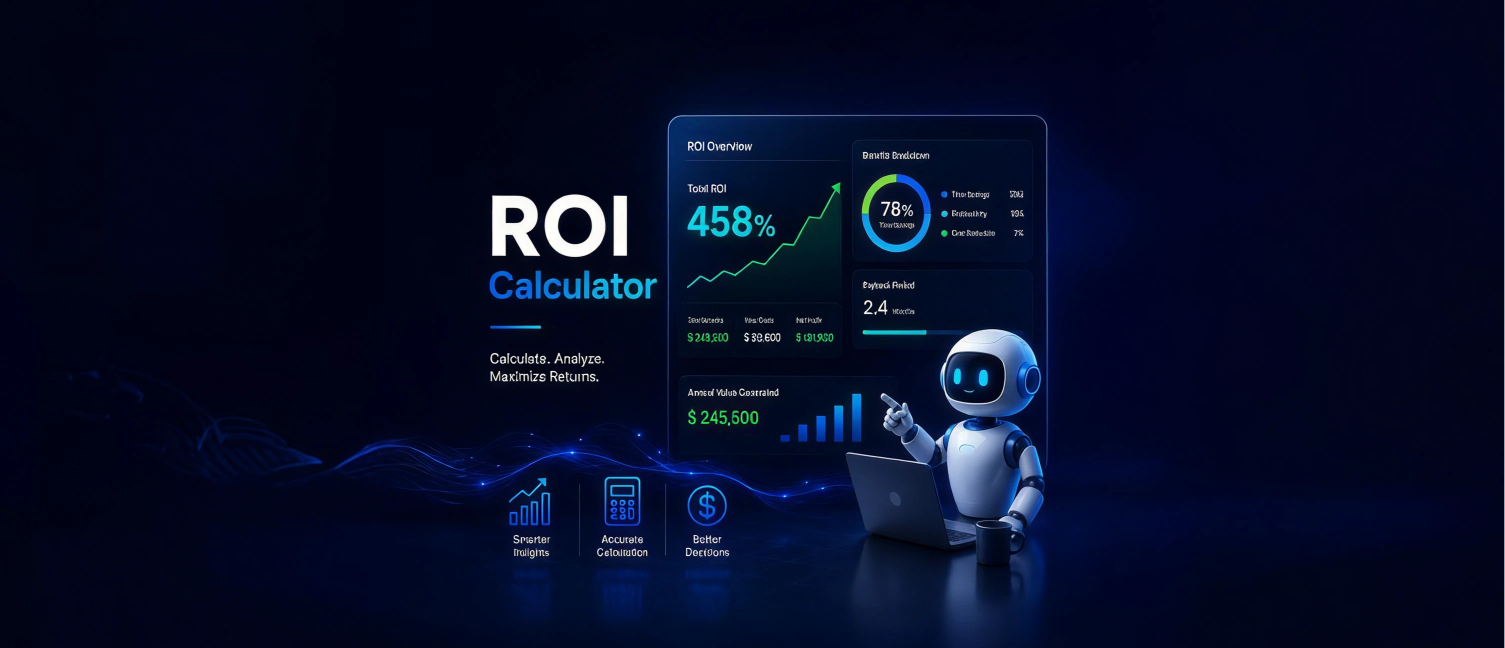
Buying a CRM is the easy part. Figuring out whether it's actually paying off? That's where most businesses get stuck.
Companies invest in CRM software hoping for more sales, better customer relationships, and a sales team that isn't drowning in spreadsheets. Then six months pass, and somebody in a leadership meeting asks the obvious question: is this thing actually working?
That's what this guide is for. We'll walk through how to calculate CRM ROI, what a CRM ROI calculator should actually measure, what counts as a "good" number based on real industry data, and a few practical ways to squeeze more value out of the CRM you've already got.
What Is CRM ROI?
CRM ROI is just a way of comparing what a CRM gives you against what it costs you to buy, set up, and run. Usually it's expressed as a ratio or a percentage. And it's not only about revenue , it covers hard returns like additional sales and cost savings, plus softer wins like productivity, cleaner data, and faster decisions across the team.
A CRM ROI calculator (some people call it a CRM benefits calculator) puts a number on all of this. Instead of a vague sense that "the CRM seems to be helping," you get something you can actually point to - useful for justifying the spend, tracking performance over time, or deciding if it's time to switch systems.
What Does the Data Actually Say About CRM ROI?
This isn't just guesswork - there's real research behind it.
Nucleus Research has tracked CRM ROI case studies for over a decade now, and its numbers have shifted quite a bit over the years - anywhere from roughly $3 to $8.71 returned for every dollar spent, depending on software costs, adoption rates, and how mature the market was at the time. One thing that tends to surprise people: according to Nucleus, time savings from productivity gains and process efficiency make up about half of total CRM ROI. That's more than the pure revenue-growth piece most businesses fixate on.
A few other things worth knowing:
Most businesses start seeing measurable ROI somewhere between 6 and 12 months after implementation.
Returns generally keep compounding over the following year, as long as adoption and data quality keep improving.
User adoption comes up again and again as the single biggest reason some CRM rollouts succeed and others quietly fail.
So no, ROI isn't fixed, and it's definitely not guaranteed just because you bought the software. It depends almost entirely on how well the CRM gets used day to day. Which is exactly why measuring it matters in the first place.
Why Measuring CRM ROI Matters More Than Just Buying One
Picking the right CRM is only step one. Whether it actually delivers anything depends on how it fits into your real, messy, day-to-day sales process—not the demo you saw during the sales pitch.
Here's the problem: without measuring ROI, most businesses only ever look at one number—the subscription fee. That means they completely miss the value showing up elsewhere, like
Faster response times to new leads
Better sales conversion rates
Stronger customer retention
Less manual, repetitive busywork
A team that's simply more productive overall
More often than not, these operational gains are worth far more than the subscription itself. You just have to actually track them to see it.
The CRM ROI Formula
Here's the standard formula:
ROI (%) = ((Financial Benefits − CRM Costs) ÷ CRM Costs) × 100
CRM Costs usually include things like:
Software subscription fees
Implementation and setup
Data migration
Training
Third-party integrations
Ongoing support
Financial Benefits usually include:
Additional revenue from better conversion
Time saved through automation (converted into a rupee value)
Money saved from fewer lost leads
Revenue from customers you kept longer
Broader productivity gains across the sales team
How to Calculate Your CRM ROI, Step by Step
Step 1: Add Up Your Costs - All of Them
Not just the license fee. Implementation, training, and integration costs get overlooked constantly, and they quietly skew your real ROI if you leave them out.
Step 2: Figure Out What You're Actually Getting Back
This is where most companies fall short—they only count direct revenue and stop there. To get a fuller picture, try quantifying the following:
Lead conversion improvement. Look at your conversion rate before and after adopting the CRM, then work out the revenue difference.
Time saved. Roughly how many hours per week is each employee saving through automation? Multiply that by their hourly cost.
Reduced lead leakage. What would those previously lost leads have been worth if someone had actually followed up?
Retention impacts. How much revenue came from customers who stuck around specifically because the relationship was managed better?
Step 3: Run the Formula
Plug your totals in and you'll get a single percentage you can compare over time or against benchmarks.
Step 4: Don't Just Calculate It Once
CRM ROI tends to improve as adoption matures, so it's worth recalculating every quarter or at least once a year. That way you catch problems early instead of six months down the line.
A Worked Example
Say a business spends ₹1,20,000 a year on its CRM. After implementation, it sees:
₹450,000 in additional revenue from improved conversion
₹80,000 saved through automation
₹70,000 saved by cutting down on lost leads
That's ₹600,000 in total benefits.
Running the formula:
((₹6,00,000 − ₹1,20,000) ÷ ₹1,20,000) × 100 = 400% ROI
Put simply, every ₹1 spent on this CRM brought back roughly ₹4, a number that lines up reasonably well with industry benchmarks for CRMs with strong user adoption.
Metrics Worth Tracking Alongside ROI
A single ROI percentage doesn't really explain why it's high or low. These supporting metrics fill in the gaps:
Metric |
What It Tells You |
|---|---|
| Lead response time | How fast your team is actually engaging new leads |
| Lead-to-customer conversion rate | How well your sales process is working |
| CRM user adoption rate | Whether people are actually using the system, or just logging in occasionally |
| Average sales cycle length | Whether deals are closing faster than before |
| Customer retention rate | Whether relationships are holding up post-sale |
| Time saved per rep per week | The real productivity gain from automation |
How to Get More ROI Out of Your CRM
If your numbers are lower than you'd like, the software is rarely the actual problem. A few things that usually move the needle:
Fix adoption first. It's the single biggest lever, and it usually comes down to better onboarding and simpler day-to-day workflows.
Clean up your data. Duplicate or inaccurate records quietly undercut every other benefit on this list.
Connect it to the tools your team already uses. WhatsApp, email, calling systems — the less friction, the more people actually use the CRM.
Automate the boring stuff first. Follow-ups, lead assignment, and reporting are usually the easiest wins.
Revisit your setup regularly. A CRM configured around last year's sales process isn't going to deliver this year's ROI.
Common Mistakes People Make When Measuring CRM ROI
The biggest one: only looking at direct sales revenue and ignoring everything else. A fuller picture should also account for:
Time saved by staff
Faster lead response times
Better conversion rates
Less lead loss
Stronger customer retention
Lower operational costs
Businesses that only track revenue often end up concluding their CRM "isn't working," when really, most of the value has just been showing up somewhere they weren't looking.
CRM Cost vs Benefit: Look Past the Subscription Price
Most companies size up a CRM by its monthly cost and stop there. Comparing cost against benefit gives a much more honest picture.
Instead of asking "what does this CRM cost us," it's worth asking:
How many leads are slipping through the cracks each month?
How many hours are going into manual, repetitive work?
How many deals are we losing because follow-up isn't consistent?
What would faster response times actually be worth in revenue?
Once you run those numbers, it's usually clear that not having a CRM - all that lost time, missed follow-up, and leaking leads - costs more than the software ever would.
What Makes the Best CRM Solutions Deliver Higher ROI?
Not every CRM performs the same, even at similar price points. The best CRM solutions tend to bundle several capabilities into one system rather than forcing your team to bounce between five different tools. Look for things like:
Lead management and scoring
Sales funnel and pipeline tracking
WhatsApp and messaging integration
Automated follow-ups
Call monitoring
Task and deadline notifications
Mobile access
Built-in reporting and analytics
This is essentially the gap a best CRM all-in-one platform is meant to close. Workpex, for instance, brings these functions together in one place instead of making you stitch together separate tools.
Why This Matters for Businesses in India
Most businesses shopping for CRM software in India start by comparing prices - which makes sense, but it's not really where ROI comes from. Choosing the right CRM software in India should be about more than affordability; it should be about finding a solution that fits your sales process and delivers measurable returns over time. ROI comes down to fit: how well the CRM matches your actual sales process, how easily it connects with tools your team already relies on (WhatsApp being the obvious one), and how quickly your people actually start using it.
A CRM that helps your team move faster and follow up consistently will almost always beat a cheaper option nobody bothers to open.
Make ROI Part of Every CRM Decision
A CRM is a business investment, not just another line item on the software budget. Using the approach above, you can put a real number on what your CRM is delivering, weigh cost against benefit properly, and make the next decision based on data instead of a hunch.
Curious how much your business could gain? Book a free Workpex demo and see how smarter lead management, automation, and faster follow-ups can improve the return on investment CRM software actually delivers.